

by Market Traders Institute
The Fed minutes from the September 15–16 FOMC meeting were scheduled for release at 2:00 p.m. ET on Wednesday, October 7, 2026. This post does not summarize what the minutes said. Instead, it gives you a process for reviewing how the dollar reacted, so the release becomes a lesson whatever the content turned out to be.
Short answer: To review the dollar’s reaction to the Fed minutes, compare what happened with the plan you wrote before the release, separate the first move from any follow-through, and record one lesson in your journal. This post is education-first. It is not a forecast, not a trade call, and not a promise of results.
Why review a scheduled release at all
A scheduled release such as the Fed minutes gives you a known time, a known event, and a plan written in advance. That makes it one of the cleanest chances to compare what you expected with what happened. Without a review, the same habits, good and bad, simply repeat at the next release.
If you prepared using a before, during, after routine, this is the “after.” For the planning side, see FOMC Minutes Wednesday: How to Plan Around a Scheduled Fed Release.
A three-step review process
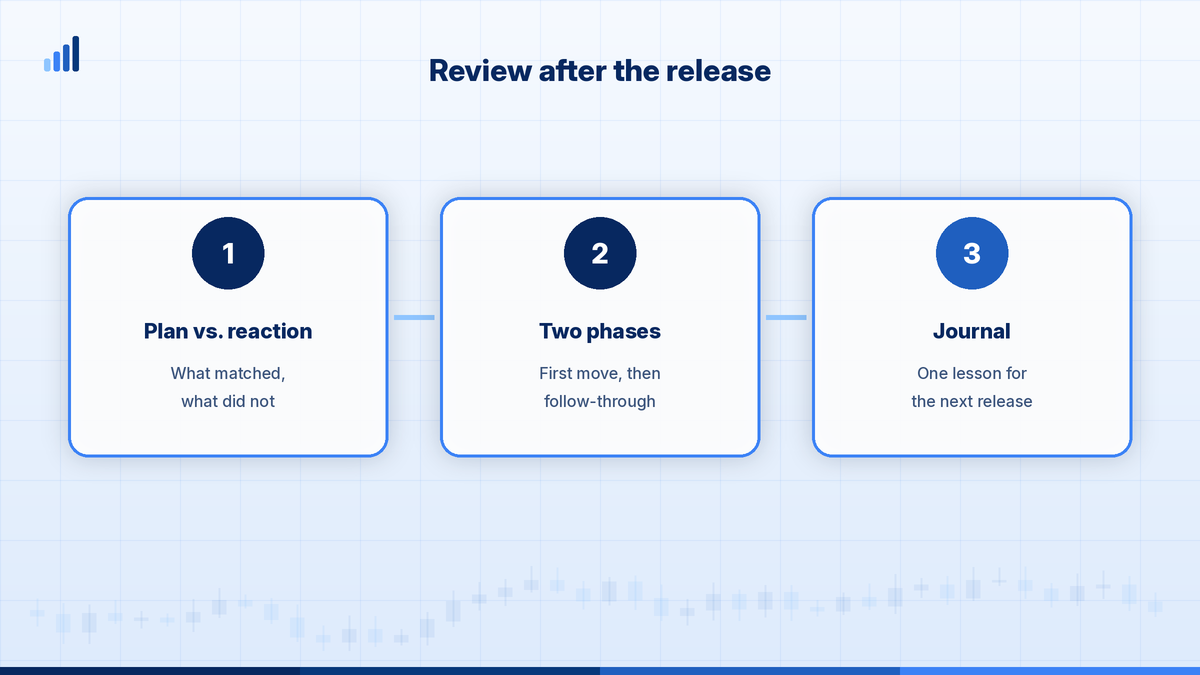
Step 1: Compare the reaction with your plan.
Start with the plan you wrote before 2:00 p.m. ET, not with the chart as it looks now. Which parts matched? Did price respect the levels you marked? Was your invalidation sentence triggered? Write down what matched and what did not, without judging the plan only by the outcome.
Step 2: Separate the first move from follow-through.
The first move is the initial reaction in the first few minutes after the release. Follow-through is what happened next: did the move extend, stall, or reverse over the following hours? If you track the US Dollar Index, the annual high of 102.54 from Monday, October 5, 2026 is one reference point for observing behavior, not a destination. Note how price behaved around the references you marked, and whether the reaction was broad across dollar pairs or limited to one.
Step 3: Journal one lesson.
Keep the entry short so you actually do it. One lesson you can carry into the next release is worth more than a long description of the chart.
A simple journal template
- Event: FOMC minutes, Wednesday, October 7, 2026, 2:00 p.m. ET.
- Plan: the pair you studied, the levels you respected, and your invalidation sentence.
- First move: direction and character (quick, choppy, or muted), described in words.
- Follow-through: extended, stalled, or reversed, and over what period.
- Other inputs: any other events in the same window that could have blended into the reaction.
- Lesson: one sentence to carry into the next release.
Common review mistakes
Rewriting the plan after the fact. Review the plan you actually wrote, not the one you wish you had written.
Treating the first move as the verdict. Early reactions to a release can be uneven. Give follow-through time to show before drawing conclusions.
Crediting everything to one event. Other events on the same day, such as Treasury auctions or scheduled remarks from Fed officials, can blend into the reaction. Note them so you do not over-attribute the move to the minutes alone.
A short checklist you can copy
- ☐ Pull up the plan you wrote before the release, with the event, absolute date, and time in ET.
- ☐ List what matched the plan and what did not.
- ☐ Describe the first move and the follow-through separately.
- ☐ Note any other events in the same window.
- ☐ Write one lesson and carry it into the next scheduled release.
None of this predicts how the dollar moves next or what the Federal Reserve decides at future meetings.
Your next practice rep
The next scheduled US release for the same routine is the September Consumer Price Index, due on Wednesday, October 14, 2026, at 8:30 a.m. ET, according to the Bureau of Labor Statistics schedule. Plan before, observe during, and review after.
Final Thoughts
The value of a scheduled release does not end at 2:00 p.m. ET. A short, honest review of plan versus reaction, first move versus follow-through, and one journaled lesson turns each release into practice for the next one.
Framework over forecasts. Process over impulse.
Frequently asked questions
What are the FOMC minutes?
The FOMC minutes are the Federal Reserve’s written summary of a past Federal Open Market Committee meeting, published about three weeks after the meeting. The minutes of the September 15–16, 2026 meeting were scheduled for Wednesday, October 7, 2026, at 2:00 p.m. ET. They describe the discussion behind a decision already made, not a new decision.
What is the difference between the first move and follow-through?
The first move is the market’s initial reaction in the first few minutes after a release. Follow-through is whether that move extends, stalls, or reverses over the following hours or sessions. Reviewing them separately helps you avoid treating the first reaction as the final verdict.
When should I review the dollar’s reaction to the Fed minutes?
There is no fixed rule. Many traders write a quick note soon after the release while it is fresh, then do a fuller review after the session or the next day, once follow-through has had time to show. The goal is a consistent routine, not a perfect read.
Want to go deeper?
Want to see educators walk through a post-release review on live charts? You can register for a live webinar to see the framework applied in real time. You can also browse upcoming sessions on our trading webinars page, or explore free lessons in our forex education hub.
No pressure. It’s just a chance to learn the framework live.
Education only. Trading involves substantial risk of loss. Nothing here is a recommendation to buy or sell any instrument.


