Ever wondered how the IMF’s lending activities can affect currency markets? We take a deep dive in today’s blog and discuss how you can stay ahead of the curve from the resulting moves! Click here to meet our top analysts and discover their trading strategies.
The world of Forex trading is a constantly evolving landscape, with a host of factors influencing currency values at any given moment.
Of the many organizations, the IMF is one that traders would be wise to keep an eye on, if they’re looking to capitalize on market movements. We’re talking about the International Monetary Fund.
The IMF’s role in providing financial guidance and assistance to its member countries is undeniable, and traders who understand its actions can learn to potentially profit from its impact.
In this blog, we’re going to take a deep dive into the IMF and understand how you can stay ahead of the curve in an ever-changing market.
Let’s get to it, starting with what the IMF is…
The International Monetary Fund
The IMF is a global organization established in 1944 that works to achieve sustainable growth and prosperity for all of its member countries. It does so by supporting economic policies that promote financial stability and monetary cooperation, which are essential to increase productivity, job creation, and economic well-being.
The group has 190 member countries with 3 critical missions: furthering international monetary cooperation, encouraging the expansion of trade and economic growth, and discouraging policies that would harm prosperity.
One of the many ways the IMF works is by lending money to member countries facing economic difficulties. And it does this in exchange for economic policy reforms.
The reforms are aimed at correcting the underlying economic imbalances and restoring economic growth.
Emergency Funds
The IMF holds “emergency funds” in the form of various currencies that can be used to provide financial assistance to its member countries. The amount of these funds, also known as the IMF’s General Resources Account, determines the IMF’s lending capacity and can affect the value of major currencies.
When the IMF provides financial assistance to a member country, it does so by issuing loans in its own currency, the SDR.
What are SDRs?
The IMF issues an international reserve asset known as Special Drawing Rights, or SDRs, that can supplement the official reserves of member countries.
The SDR is not a currency but it is a potential claim on the freely usable currencies of IMF members. As such, SDRs can provide a country with liquidity.
A basket of currencies defines the SDR: the US dollar, Euro, Chinese Yuan, Japanese Yen, and the British Pound.
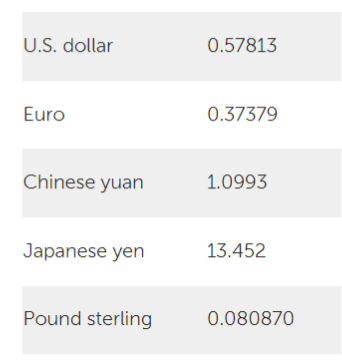
Now, the International Monetary Fund (IMF) last announced the new amounts for the five currencies in August 2022 which will determine the value of the SDR during the new valuation period that runs from August 1, 2022 until July 31, 2027.
The value of the SDR here is the sum of the values of the following amounts of each currency. Have a look:
Source: IMF
Why SDRs, you ask?
Well, adding SDRs to a country’s international reserves makes it more resilient financially. In times of crisis, a country can dip into its savings for urgent needs (e.g., to pay for importing vaccines).
During the 2009 global financial crisis to give liquidity in the global economic system more than $180 billion SDR was allocated and it is usually held by a few organizations and IMF member countries.
How are SDRs exchanged?
Central banks of the borrowing country must exchange their own currency for SDRs, which they then use to meet their balance of payments needs.
This exchange of currencies can affect the value of the borrowing country’s currency, as well as the currency of the country supplying the SDRs.
For example, if the IMF provides financial assistance to a country using SDRs that have a higher weightage of the U.S. dollar, then the demand for the U.S. dollar will increase, which could cause its value to appreciate relative to other currencies.
This appreciation of the dollar could also impact currency pairs, and traders could learn to potentially profit from the fluctuations by keeping a close eye on IMF lending activities.
The Reserve Ratio
Another way the IMF influences currency markets is by recommending the reserve ratios of different currencies.
The reserve ratios determine the amount of each currency that’s held as reserves by central banks.
The IMF reviews the reserve ratios of different currencies periodically and makes recommendations as necessary to reflect changing economic conditions.
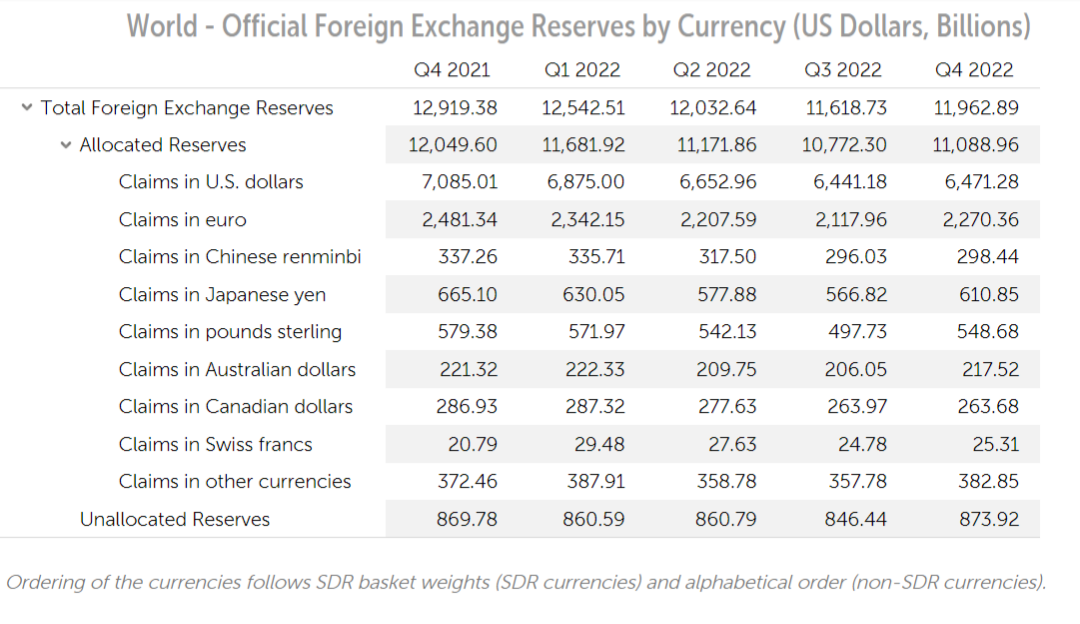
Here’s a look at the currency Composition of Official Foreign Exchange Reserves (COFER) by IMF:
Source: IMF
Any increase or decrease in these reserves can have an impact on markets.
When central banks hold more of a particular currency in their reserves, it can likely impact the value of that currency relative to other currencies.
It can make exports for a nation more expensive and imports cheaper. The same can also impact markets, say for traders who are holding positions in a particular currency pair. The increase or decrease in a currency value could result in potential profits or losses, depending on their positions in the currency.
In conclusion, the International Monetary Fund plays an important role in the global economy and its actions can impact currency markets.
And the interesting thing about it is you can learn to trade these moves! See how here.
As Q2 kicks off, the markets are getting more volatile by the day with China and Brazil striking a deal to discard the U.S. dollar. Click here to learn how you can trade these shifts LIVE with our top analysts.
If you wish to take your trading game to the next level, check out our Forex Cheat Sheet.
This sheet helps you master your candlestick charts and identify potential profitable trading opportunities…in no time! Click here to get it today >>
Predictions are not a guarantee of this or any result. Information provided on this prediction is for general information purposes only. We offer no representation or warranty with regard to this prediction. No prediction is personalized or otherwise directed at any individual or particular circumstances. We disclaim and will not accept any liability for losses associated with this prediction.
Some of the information presented may be provided by a third party. MTI is not responsible for any claims, products, services, or information provided by any third parties. MTI does not provide any warranty or representation as to any third party data. MTI expressly disclaims any responsibility and accepts no liability with respect to such third party information, services, and/or products. The third party data is provided for convenience only and is in no way meant to imply an endorsement by MTI or any other relationship.
Please see our full risk disclaimer.